South Africa 2026 Budget Highlights
South African taxpayers can breathe a little easier following the positive budget presented by Finance Minister Enoch Godongwana. The 2026 Budget introduces inflation-linked increases to personal income tax brackets, thresholds, rebates, and medical aid tax credits.
Stronger-than-anticipated revenue collections - revised upward by R21.3 billion - allowed National Treasury to avoid introducing major new taxes, while simultaneously charting a credible path to debt stabilisation for the first time in 17 years.
ECONOMIC HIGHLIGHTS
Debt Stabilisation - First in 17 Years
Gross national debt is projected to stabilise at 78.9% of GDP in 2025/26 and decline to 76.5% by 2028/29 — a historic turning point after nearly two decades of rising debt.
Deficit Narrowing on Track
The consolidated budget deficit narrowed to 4.5% of GDP in 2025/26. Treasury projects further improvement to 4.0% in 2026/27 and 3.1% by end of the medium-term framework.
Revenue Surprise - No New Taxes
Gross tax revenue was revised upward by R21.3 billion, removing any need for additional tax increases. A primary surplus of 0.9% of GDP provides a platform for growth investment.
GDP Growth Accelerating
Real GDP growth is forecast at 1.6% in 2026, rising to an average 1.8% and reaching 2.0% by 2028 as structural reforms and infrastructure investment take hold.
TAX HIGHLIGHTS FOR INDIVIDUALS
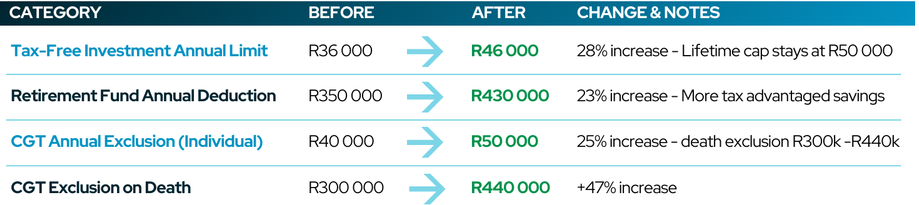
After two years without changes, the 2026 Budget delivers meaningful inflation-linked relief. The following increases benefit individual taxpayers directly:
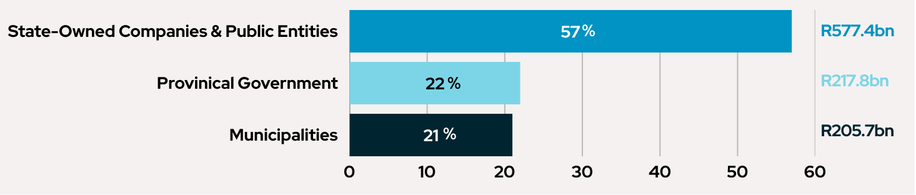
R1 TRILLION + INFRASTRUCTURE INVESTMENT
Public-sector infrastructure spending over the medium-term expenditure framework
POTENTIAL RISKS TO THE POSITIVE TREND
Despite the optimistic fiscal outlook, certain risks could reverse these trends:
Political Instability
Coalition tensions within the Government of National Unity could disrupt policy continuity and undermine market confidence underpinning the current outlook.
Policy Implementation Risk
The effectiveness of structural reforms depends on execution. Delays in energy, logistics, and public administration reform could dampen the growth trajectory.
Global Economic Shocks
Adverse external developments - geopolitical conflicts, US monetary policy shifts, or commodity price volatility - could negatively impact South African markets and the Rand.
KEY TAKEAWAYS FOR INVESTORS
Debt stabilises for the first time in 17 years a genuine fiscal turning point signalling improved government discipline and a declining interest burden over time.
No new taxes higher-than-expected revenue collections meant taxpayers were spared further burden, supporting consumer confidence.
Meaningful tax relief increases to TFI limits, retirement deductions, and CGT exclusions benefit investors and retirement savers directly.
R1 trillion infrastructure push the scale of public investment, if executed, should support economic activity, employment, and long-term productivity.
GDP growth accelerating to 2% while modest by emerging market standards, sustained improvement creates a healthier backdrop for local equity and fixed income returns.
CONCLUSION
The 2026 Budget marks a credible step forward in South Africa's fiscal consolidation journey. While risks remain, particularly around political cohesion and global headwinds, the combination of debt stabilisation, revenue buoyancy, and infrastructure commitment provides a more constructive investment backdrop than seen in many years. By closely monitoring political stability, policy implementation, and global economic conditions, investors can effectively navigate potential risks and seize emerging opportunities in the South African market.
We grow your wealth by combining active and passive management in an innovative matrix. GIB has been able to continues to deliver while reducing costs and increasing efficiency. Grow you wealth today
Learn more