The Iran War and Beyond: Market Impact
Our Base Case: A Contained but Consequential Conflict
The outbreak of military hostilities involving Iran has introduced a new layer of geopolitical uncertainty into global markets. While the situation carries material near-term risk, our base case anticipates a relatively contained conflict, with the following key assumptions underpinning our analysis:
No commitment of US boots on the ground in Iran - engagement remains air and naval.
Iran's military capacity is severely degraded, limiting sustained escalation capability.
New Iranian leadership emerges that is likely to adopt a more pragmatic diplomatic posture.
The transition period, however, carries meaningful tail risk. Iranian retaliation, whether direct or via proxy, could escalate volatility materially in the weeks ahead, particularly as a leadership vacuum creates unpredictability. Markets should be prepared for headline-driven swings before stability is restored.
Near-Term Outlook: Key Market Dynamics
Oil & Energy Markets
The most significant and immediate market impact is expected in energy. Oil infrastructure across the Middle East remains highly vulnerable during active hostilities. A sustained disruption to supply - even a partial one - would push Brent crude meaningfully higher, with implications that ripple across the global macroeconomic outlook.
Critically, higher oil prices on a prolonged basis will reduce the probability and pace of interest rate cuts - not only in the United States, but in emerging market economies including South Africa. Central banks that had been on the cusp of easing will be forced to reassess, keeping monetary conditions tighter for longer.
Equities
We expect a moderate risk-off environment to persist over the coming days and potentially weeks. Global equities will face near-term selling pressure, with the scale of the drawdown dependent on whether the conflict escalates or de-escalates. A prolonged conflict may also trigger broader growth concerns and weaker industrial commodity prices, compounding equity headwinds.
South African equities will not be immune. However, the JSE's significant exposure to precious metals provides a meaningful structural buffer relative to most EM peers. The historical charts below illustrate how the JSE All Share and S&P 500 indices have navigated prior geopolitical shocks - a useful frame for contextualising the current episode.
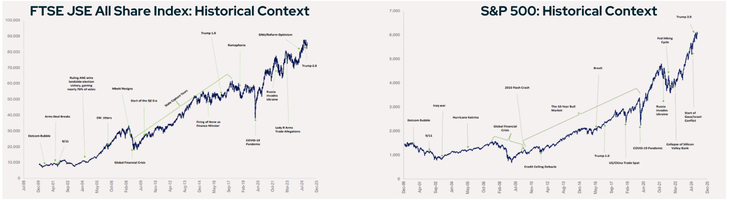
The charts serve as a powerful reminder; markets have recovered from every prior geopolitical shock - 9/11, the Global Financial Crisis, COVID-19, and multiple regional conflicts. The current episode, in our base case, is unlikely to prove an exception.
Safe Havens & US-Specific Dynamics
A distinctive feature of the current episode compared to some recent market downturns is the relative strength we anticipate from traditional US safe havens. We expect the US dollar and US Treasuries to outperform their historical role during geopolitical stress periods, for several structural reasons:
The US dollar and Treasuries remain the world's default flight-to-safety assets. This dynamic is unlikely to change materially in the near term despite ongoing debate around USD reserve currency status.
The US holds a structural energy advantage as a net exporter of crude oil. The recently secured Venezuelan oil supply chain adds further resilience to this position.
The US has successfully demonstrated renewed military and geopolitical authority through this engagement, reinforcing the credibility of the dollar as a safe-haven anchor.
Gold and precious metals are expected to perform well in this environment. We continue to see physical holdings of gold and platinum group metals (PGMs) as compelling both for capital preservation and medium-term growth potential.
Implications for Emerging Marketing & South Africa
The combination of higher oil prices and a stronger US dollar is an historically unfavourable backdrop for emerging market assets. EM currencies, equities, and bonds may face relative underperformance in this environment, with the pressure felt across asset classes.
South Africa is not exempt, but it is better positioned than many EM peers:
SA's precious metals sector - gold and PGMs - provides a natural hedge and potential outperformer relative to the broader JSE.
SA bonds may face initial selling pressure as risk premiums widen. However, any substantial yield spikes should be viewed as a tactical buying opportunity, given the still-attractive real yield environment relative to DM peers.
SA currency hedges embedded within JSE-listed multinational and resource counters offer additional portfolio protection for local investors.
DESTINY POSITIONING
Our local asset managers continue to favour physical gold and PGMs for stability and growth.
Our SA bonds managers continue to see local bonds providing tactical opportunity on any significant yield spike.
Navigating Extreme Volatility: A Practical Guide for Investors
Periods of extreme market volatility are psychologically and financially demanding. History, however, offers a clear lesson; investors who fare worst are not those exposed to volatile markets, they are those who react impulsively to them. The charts above tell this story compellingly. Every significant drawdown - the Dotcom crash, the Global Financial Crisis, COVID-19 - was followed by recovery and, ultimately, new highs. The current geopolitical episode, however serious, does not change this fundamental dynamic.
1. Resist the Urge to Panic-Sell
The single most damaging mistake investors make during crises is crystallising losses by selling into a falling market. Volatility is not the same as permanent loss of capital - but selling during a downturn converts temporary paper losses into real ones. Unless your personal financial circumstances have materially changed, the discipline of staying invested is almost always superior to attempting to time an exit and re-entry. Markets move faster than decisions; by the time the “all clear” feels safe, the bulk of the recovery has typically already occurred.
2. Revisit Your Asset Allocation - Do Not Abandon It
A well-constructed portfolio is designed precisely for moments like this. If significant drawdowns feel intolerable, the appropriate response is not to exit markets but to reassess whether your strategic allocation genuinely reflects your risk tolerance and investment horizon. Investors with longer time horizons can afford to hold through volatility; those with near term liquidity needs should ensure they have adequate cash reserves and short-duration assets to meet obligations without being forced to sell growth assets at depressed prices. Rebalancing - trimming assets that have held up and adding to those that have sold off - is often the disciplined investor’s most powerful tool in volatile markets.
3. Lean Into Quality and Real Assets
Not all assets are equal in a geopolitical crisis. Quality equities - companies with strong balance sheets, pricing power, and durable earnings - tend to outperform speculative or highly leveraged names during drawdowns. Real assets, particularly physical gold and PGMs, have a well-established record as stores of value during periods of uncertainty and currency stress. For South African investors specifically, rand-hedging equities and commodity exporters offer a natural buffer against both local currency weakness and global risk aversion. Ensure your portfolio has meaningful exposure to these stabilising asset classes before volatility peaks, not after.
4. Treat Yield Spikes as Opportunity, Not Warning
In the fixed income space, risk-off selling can push bond yields sharply higher in the short term, creating what often proves to be an attractive entry point for medium-term investors. South African government bonds, should they sell off materially in response to global risk aversion and oil-driven inflation concerns, may offer compelling real yields for investors with a 12 to 36-month horizon. Positioning ahead of any eventual central bank easing cycle - which higher oil prices may delay but not permanently derail - can generate meaningful capital gains in addition to elevated income.
5. Maintain Cash Reserves - But Deploy Them Strategically
Having dry powder is a genuine strategic advantage in periods of extreme market dislocation. Investors who enter a crisis with sufficient liquidity are able to deploy capital at depressed valuations, meaningfully improving their long-run return profile. Cash should not be viewed as a permanent hiding place - the real value of uninvested cash is steadily eroded by inflation - but as a tactical reserve. A phased deployment approach, committing capital in tranches as markets sell off, reduces the risk of mistiming a single large re-entry and allows investors to benefit from rand-cost averaging into dislocated prices.
6. Tune Out the Noise - Anchor to Fundamentals
Geopolitical crises generate an overwhelming volume of information, much of it speculative, contradictory, and emotionally charged. Successful long-term investors have always had to resist the gravitational pull of daily headlines. Anchor your decision-making to the fundamentals that drive long-run asset values: corporate earnings power, dividend sustainability, balance sheet quality, valuation levels, and your own financial plan. If your investment thesis for a holding has not materially changed, the volatility around it is signal noise - uncomfortable, but not actionable. Engage your financial adviser before making significant portfolio changes in response to short-term events.
We grow your wealth by combining active and passive management in an innovative matrix. GIB has been able to continues to deliver while reducing costs and increasing efficiency. Grow you wealth today
Learn more